
Editorial Fashion Magazine Cover Prompt for ChatGPT
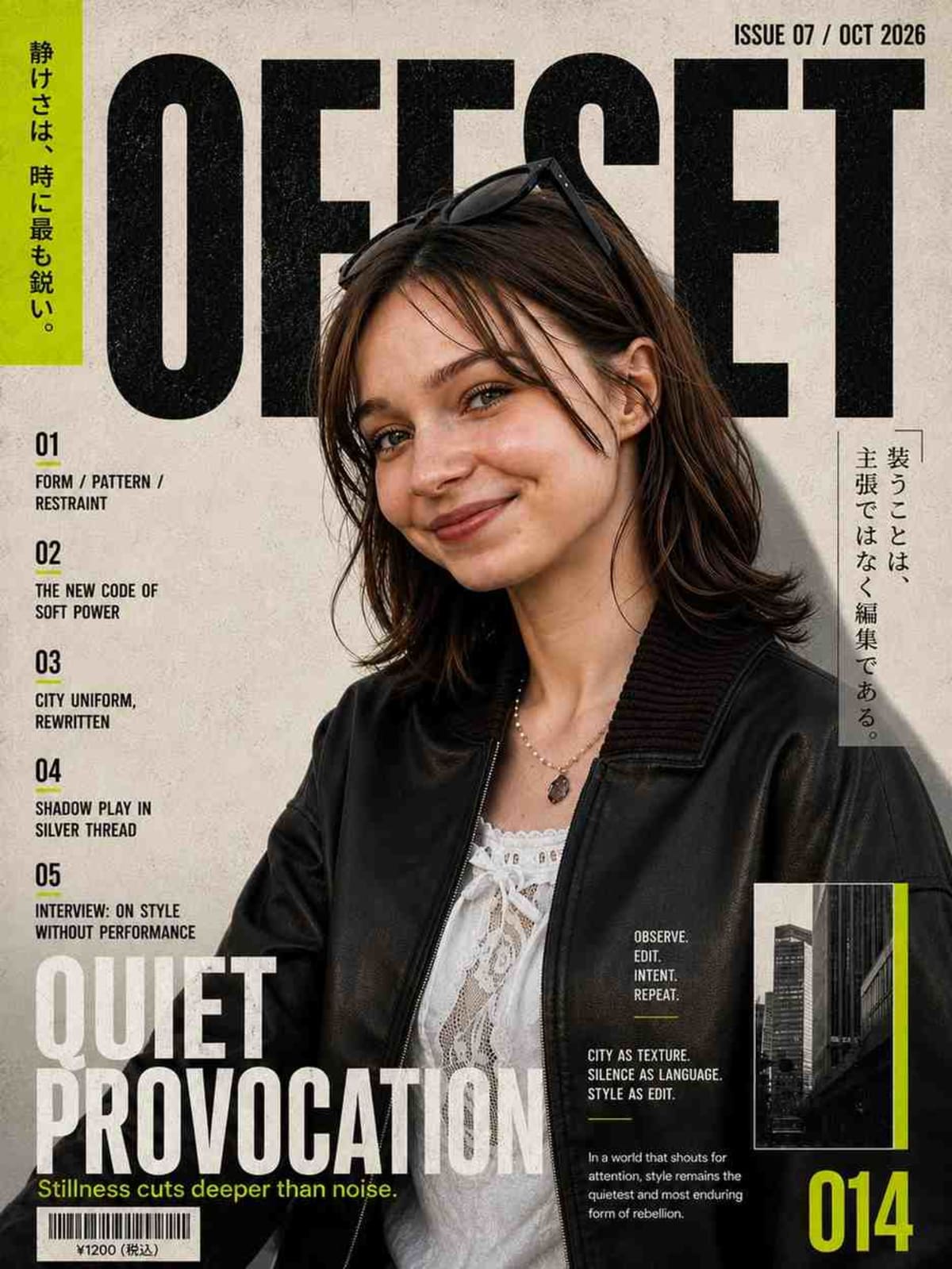
This prompt transforms a portrait source into a high-end editorial fashion magazine cover with minimalist Japanese styling.
Prompt Text
Ready to copy & executeUsing REFERENCE_0 as the portrait source, transform it into a high-end editorial fashion magazine cover while preserving the person's facial features, hairstyle, clothing, pose, lighting direction, natural shadows, and overall identity.
Create the design in a vertical 3:4 aspect ratio.
Crop closer into a premium editorial composition while placing the subject slightly right of center.
Use a textured off-white paper background with subtle realistic print grain.
Add huge bold condensed black typography reading:
OFFSET
Position it across the top, partially hidden behind the subject.
Top Right:
ISSUE 07 / OCT 2026
Left Edge:
Vertical neon yellow-green strip.
Japanese text:
静けさは、時に最も鋭い。
Bottom Left Headline:
QUIET PROVOCATION
Subtitle:
Stillness cuts deeper than noise.
Left Column:
01 FORM / PATTERN / RESTRAINT
02 THE NEW CODE OF SOFT POWER
03 CITY UNIFORM, REWRITTEN
04 SHADOW PLAY IN SILVER THREAD
05 INTERVIEW: ON STYLE WITHOUT PERFORMANCE
Upper Right:
Vertical Japanese Quote
装うことは、主張ではなく編集である。
Lower Right:
Small black-and-white city building inset with neon green accent.
Editorial Text:
OBSERVE.
EDIT.
INTENT.
REPEAT.
CITY AS TEXTURE.
SILENCE AS LANGUAGE.
STYLE AS EDIT.
Include one small editorial paragraph beneath.
Bottom Right:
Large page number
014
Neon yellow-green.
Bottom Left:
Barcode with price
¥1200 (税込)
Maintain:
Minimalist Japanese editorial style
Luxury fashion magazine appearance
Realistic print texture
Distressed ink
Professional typography
Premium composition
Sharp realistic face
Natural skin texture
High contrast
Luxury editorial photography
No face blur
No extra accessories
No body distortion
No AI artifacts
Photorealistic quality.Introduction
Designed for use with ChatGPT, this prompt guides the transformation of a reference portrait into a sophisticated magazine cover layout. It integrates bold typography, Japanese text elements, and a textured print background while preserving the subject's identity and features. The resulting layout mimics a professional publication with strict art direction.
Prompt Details
Concept & Creative Objective
To generate a photorealistic luxury fashion magazine cover featuring a specific portrait reference, accented with minimalist Japanese text, stark contrast, and neon yellow-green graphical details.
Why This Prompt Works
The prompt relies on explicit structural directives, such as a vertical 3:4 aspect ratio, precise placement coordinates for typography, and clear design elements like an off-white paper background with print grain. By defining exact text callouts, placement locations, and stylistic constraints, it leaves minimal ambiguity for the generator.
Prompt Breakdown
Key instructions include utilizing REFERENCE_0 as the portrait source, cropping closer into a premium composition, placing the subject slightly right of center, and adding specific typographic elements such as the main title OFFSET, Japanese quotes, issue numbers, and a barcode. It also mandates specific design parameters like distressed ink, natural skin texture, and a minimalist Japanese editorial style.
Instructions
Customization Tips
You can swap out the title text or update the Japanese quotes to match your own thematic concepts. The issue number, date, and price elements can also be altered to reflect different editions or currencies.
Generation Best Practices
Ensure you provide a clear and distinct portrait source as REFERENCE_0 to maintain the subject's facial features and overall identity during the transformation process.
Help & Answers
Frequently Asked Questions
This prompt transforms a provided portrait source into a high-end editorial fashion magazine cover featuring minimalist Japanese styling and precise typography.